We recently had a question about whether a judge could order a couple who had not lived together for over a year to do so before granting a divorce. Under no circumstances can a judge order them to live together for any amount of time. The closest thing to what you say is that a judge can refuse to grant the divorce if he believes there is a a possibility of reconciliation. The Divorce Act says:
——————————-
(2) Where at any stage in a divorce proceeding it appears to the court from the nature of the case, the evidence or the attitude of either or both spouses that there is a possibility of the reconciliation of the spouses, the court shall
(a) adjourn the proceeding to afford the spouses an opportunity to achieve a reconciliation; and
(b) with the consent of the spouses or in the discretion of the court, nominate
(i) a person with experience or training in marriage counselling or guidance, or
(ii) in special circumstances, some other suitable person,
to assist the spouses to achieve a reconciliation.
———————————-
In actual practice the only evidence on this issue that the judge will have in an uncontested divorce will come from the affidavit(s) of the applicant(s) which will just state that there is no possibility of reconciliation and the judge will accept that.
Under section 9 of the Divorce Act a lawyer has the duty to discuss the issue of reconciliation with his/her client and inform him/her about “marriage counselling or guidance facilities” and “mediation facilities” for assisting in negotiating terms of divorce.
Getting a divorce is never easy. But when you have to deal with high legal bills along with everything else it can be scarier than it has to be. We have come up with several ways you can keep your legal costs under control.
. Is a lawyer really necessary? Often the answer is “yes”. Where else can you go to find out what your legal rights and responsibilities are? But after you get the answers to your questions if may be possible for you to take care of the remainder of your divorce by yourself – possibly with just a little help.
The vast majority of divorce cases are uncontested – the spouses have agreed on the terms of divorce. The relationship is over and needs legal closure. You cannot expect the court office to prepare your paperwork for you but there are some affordable alternatives to law firms.
The first is a do-it-yourself divorce kit. This is really a workbook with a lot of fill-in-the-blank type forms. They usually cost between $20 and $40 and you can find them at most bookstores and stationary stores. Expect to spend many hours figuring out how to fill in the forms but you will save a lot of money in the end.
A second way to go is to hire an online service that will take your information, prepare your forms, and email them to you along with specific instructions allowing you to file them at the court office yourself. For a couple of hundred bucks this is far easier than the do it yourself kit and still saves loads of money compared to hiring a lawyer to do it all for you.
2. Consider mediation. In the mediation process you are still in the driver’s seat, no judge gets involved and lawyers are optional. Instead a mediator, a professional trained in assisting spouses to negotiate with each other, will help you settle any issues you have been unable to agree upon. Even touchy issues are usually successfully resolved when both spouses are prepared to give mediation their best effort.
Compared to a divorce trial which you can expect to cost each spouse tens of thousands of dollars, mediation will only cost a few thousand each, possibly even less.
3. If you need legal advice see how much of it you can get for free by taking advantage of the common 30 minute free consultation. Be sure to ask if the lawyer offers these freebies before you make an appointment. They are common enough that if you call around you should be able to find someone who will talk to you for a while for free.
4. Although almost all lawyers charge based on an hourly rate, they will bill you for every single minute they spend working on your file. That means writing, dictating, preparing documents, and even just speaking to you briefly on the phone. Every minute is costing you money so don’t make frequent calls for updates. Instead establish some regular reporting system up front such as arranging to receive a copy of all letters and documents or a monthly report letter.
5. Some, but not most, lawyers will agree to bill you a flat fee for your divorce. It won’t be cheap but at least it will give you the peace of mind of knowing what the damage is right from the start. If you need to arrange financing it helps to know how much you will need to borrow or set aside. You and your lawyer can then focus exclusively on results.
If you choose to hire a lawyer to oversee your Canadian divorce, in most cases you will notice that divorce lawyers in Canada do their best to keep you and your spouse from taking your dispute all the way to the court. This is because all lawyers have been taught to help lessen the burden on the already overburdened court docket by attempting to settle cases out of court.
Your lawyer will negotiate on your behalf with your spouse’s lawyer through a document known as an offer to settle. There is a formal version of the offer to settle, but it is also possible that your lawyer may choose to use the informal version. Do not be alarmed by the word informal; the informal version is still legally enforceable in every sense if accepted by the other party.
What you should be alarmed about, however, is that in many cases, informal offers to settle cannot be raised in court. This is due to a two-word phrase which lawyers often use. The phrase is without prejudice and it is a lawyer’s way of keeping communication private and out of court.
But, how important could this be? Potentially very important. The following scenario is a common occurrence and nicely demonstrates the disadvantages of using an informal offer to settle. Assume that you make a reasonable offer to your spouse in an attempt to settle a specific issue related to your divorce, but your spouse refuses your offer. He or she then brings the case before the court, where the judge decides the case in a manner similar to your earlier offer which your spouse had declined.
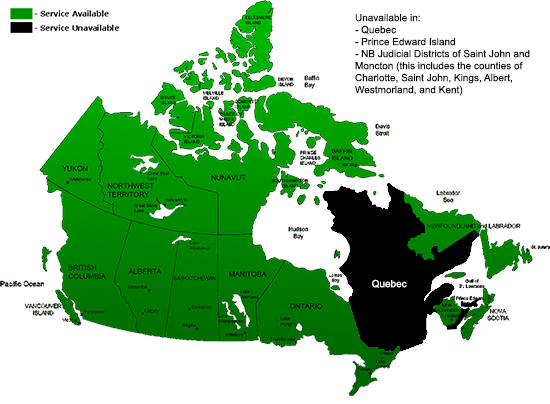
“For a fast, low-cost, lawyer-free legal www.DivorceOnline.ca.â€
Most divorces processed today are so-called “no fault” divorces. This means simply that the grounds for divorce are neutral and do not require proof that one spouse is at fault. Technically in Canada there is only one ground for divorce, which is the breakdown of the marriage. However, this breakdown can be considered to have occurred in one of three different ways:
. Cruelty. This can be either physical or mental cruelty but needs to be severe enough that the continuation of the relationship becomes unreasonable. A single instance of verbal abuse is unlikely to cross this threshold but a pattern of verbal abuse would suffice. If the evidence shows that the cruelty has been forgiven by the spouse who was the victim, it cannot be used as a basis for divorce.
2. Adultery. Sexual intercourse with a person of the opposite sex, other than one’s spouse, constitutes adultery. If it is something short of intercourse or involves homosexual acts there is some question as to whether adultery can be used. When adultery is used as a basis for divorce it cannot have been forgiven previously and only the non-adulterous spouse can apply on this basis. There can be no joint application on grounds of adultery.
3. Separation for at least 2 months. This is by far the most common ground and we have dealt with it in detail in other posts.
The term “family lawyer” usually refers to a lawyer who has decided to focus most, or even all, his or her professional law practice on representing those involved in family law disputes. Alternatively, it may be that you live in a small town with few lawyers to chose from or for any one of a number of other reasons you have hired someone with a general practice who only works in the field of family law as a small part of his or her general practice.
In theory, any lawyer who is qualified to practice law in your jurisdiction is qualified to represent you on a family law matter. However, in practice, stick with a real family lawyer – one whose focus on family law allows him or her to stay current on all the case law, the changes in legislation and the rules of practice.
A lawyer who has decided to become a family lawyer will typically be more attuned to the value of alternative dispute resolution, such as mediation, in resolving family disputes. Mediation can usually result in a settlement acceptable to both spouses without exacting the same toll in terms of money, time and stress as going to court. Beware of a family lawyer who does not encourage you to at least strongly consider mediation.
There is a recent trend among family lawyers to favour what is referred to as collaborative approach to family law. Accordingly, collaborative family lawyers may go so far as to explain to their clients that they will advise them and represent them throughout negotiations and getting court approval for a settlement but will not litigate on their behalf. The fact that this approach is growing in popularity is testament to the increasing realization of the harmful effects of court battles on couples, especially where a continuing relationship as co-parents needs to be preserved.